Brain Physiology:
Representation
ID: 85b03664-e44a-4ba2-96f8-636cdd41b7c8
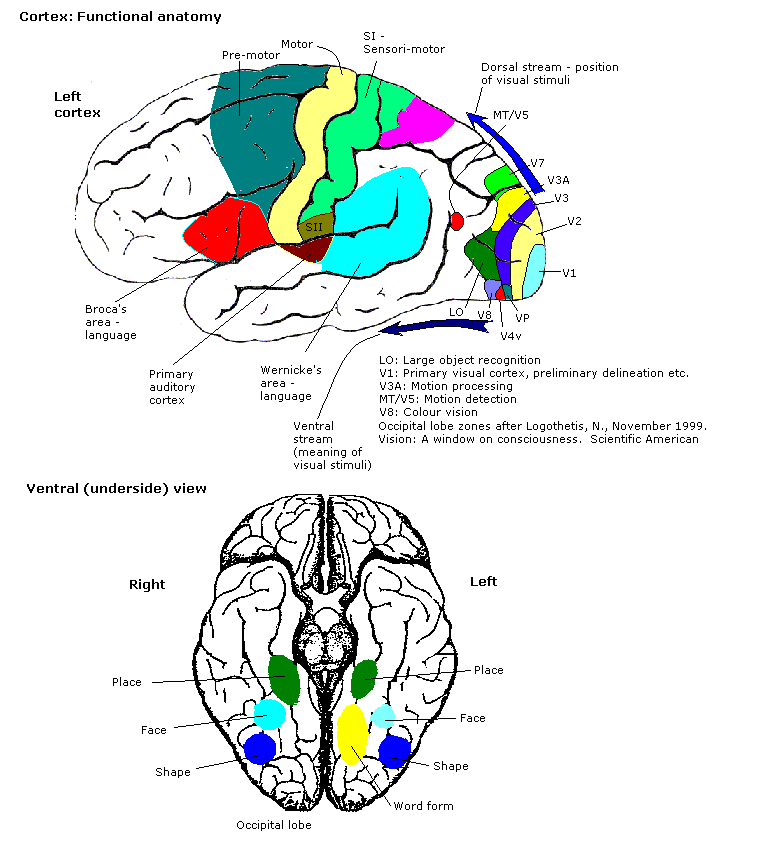
Description
- Cerebrum
- Corpus Callosum
- Pathway to connect left and right hemisphere of brain
- Cerebral Cortex
- Folded structure of cerebrum
- Frontal Lobe
- Part of cerebral cortex just above the eyes
- Voluntary Movement, Planning, High level Cognitive Skills such as problem
solving
- Parietal Lobe
- Region just behind the frontal lobe
- Responsible for sensory processing and some visual processing
- Occipital Lobe
- Part of cerebral cortex at the back of the head
- Visual processing: Recognizing color and shapes and understanding visual
input
- Temporal Lobe
- Part of C.C. at the sides of the head
- Responsible for visual processing and interpreting auditory information.
- Hippocampus
- Curved structure below cerebral cortex
- Responsible for forming memories
- Amygdala
- Responsible for integrating emotions and memories
- Limbic System
- Hippocampus and amygdala together
- Responsible for regulating emotion and motivation
- Thalamus
- Sensory information and relay it to other parts of the brain
- Forebrain
- All these structures with cerebral cortex
- Midbrain
- Beneath the thalamus
- Coordinate eye movement such as blinking, focusing , triggering reflexes
based on loud noise
- Fine motor control skills such as writing with pen or playing a musical
instrument
- Hindbrain
- Glucose regulation, sleep and help control movement
-
Basal Ganglia
- Cerebellum
- Tucked underneath occipital lobe
- Coordinate movement and learn new motor skills
- Pons
- Breathing and posture control
- Medulla
- Nerve pathways from brain to spinal cord
-
Brainstem
- Thalamocortical loops and EEG
- Brain Waves Frequencies